
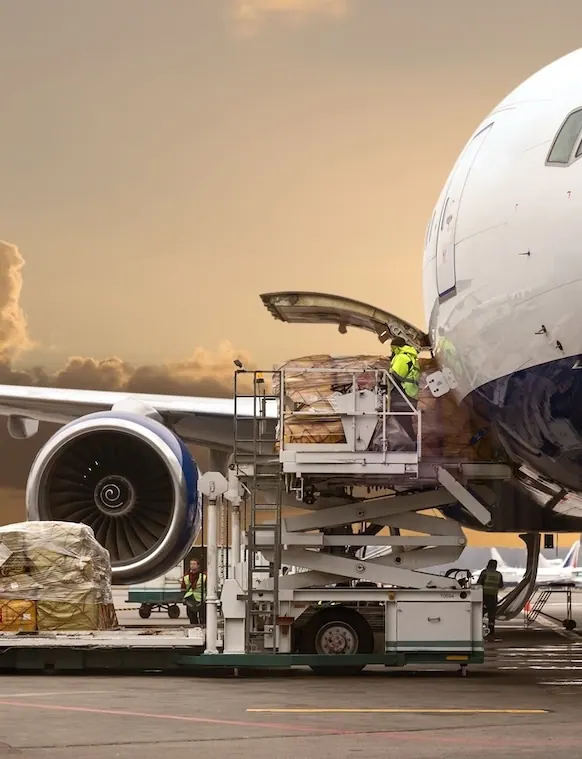
Air cargo, airport to airport and door to door
Air Freight
Air freight moves cargo in the hold of passenger or freighter aircraft, airport to airport in one to three days and door to door in three to seven. QShip books space from Delhi (DEL), Mumbai (BOM) and Bengaluru (BLR), files export customs, and clears and delivers at the destination. It is priced on chargeable weight.
What is chargeable weight and how is it calculated?
Airlines charge on whichever is greater: the actual weight of the shipment, or its volumetric weight. Volumetric weight is the volume in cubic centimetres divided by 6,000. A carton measuring 60 by 40 by 40 cm has a volumetric weight of 16 kg, so if it actually weighs 9 kg you pay for 16. Light, bulky goods are always charged on volume.
| Cargo | Actual weight | Volumetric weight | Charged on |
|---|---|---|---|
| 10 cartons of cotton garments, 60 x 40 x 40 cm | 90 kg | 160 kg | 160 kg volumetric |
| Two cartons of brass fittings, 40 x 30 x 30 cm | 58 kg | 12 kg | 58 kg actual |
| One pallet of home decor, 120 x 100 x 120 cm | 210 kg | 240 kg | 240 kg volumetric |
Rates fall in weight breaks, commonly at 45, 100, 300, 500 and 1,000 kg. A 280 kg shipment is sometimes cheaper billed as 300 kg at the lower rate, and we check that on every quote.
How long does air freight from India take?
Flight time is a day or less. The rest is handling: acceptance and screening at origin, transit if the routing is not direct, and customs at destination. Consolidated (deferred) services are cheaper and a day or two slower than direct airline bookings.
| Destination | Airport to airport | Door to door |
|---|---|---|
| Dubai (DXB) | Same day to 1 day | 2 to 3 days |
| London (LHR) | 1 to 2 days | 3 to 5 days |
| Frankfurt or Amsterdam | 1 to 2 days | 3 to 5 days |
| New York (JFK) | 1 to 3 days | 4 to 6 days |
| Los Angeles (LAX) | 2 to 3 days | 5 to 7 days |
What documents does an air export from India need?
- Commercial invoice and packing list with HS codes, weights and dimensions per piece
- Shipping bill filed on ICEGATE against your IEC and AD code
- Air waybill, issued by the airline or the consolidator's house air waybill
- Security declaration and screening under the BCAS Regulated Agent programme
- MSDS and dangerous goods declaration for batteries, aerosols, perfumes and similar
- Certificate of origin or GSP form where the buyer claims a duty preference
When does air freight beat ocean freight?
- Consignments under about two CBM or 300 kg, where LCL destination charges outweigh the air premium
- Restocking a marketplace listing that is about to run out of inventory
- Samples, prototypes and first orders where a buyer is waiting
- High-value goods where six weeks of working capital at sea costs more than the freight difference
- Perishables and seasonal stock with a fixed selling window
Above about 500 kg the arithmetic usually turns. A 40 ft container of garments costs a fraction of the air freight for the same goods, and if the sailing fits the sales calendar, sea wins.
Direct airline booking or consolidation?
A direct booking puts your cargo on a master air waybill in your name on a specific flight. A consolidation groups several shippers under one master air waybill with house air waybills for each, and the consolidator's volume buys a lower rate. For most e-commerce replenishment, consolidation is the sensible default. For a launch deadline, direct is worth the premium.
How does a air freight booking work with QShip?
- 1
Send piece dimensions and weights
Per carton or pallet, plus commodity and destination. We calculate chargeable weight and quote at the right weight break.
- 2
Book the flight
Direct or consolidated, with the acceptance cut-off at the air cargo terminal confirmed to you.
- 3
Pick up and screen
Cargo is collected, screened under the Regulated Agent scheme and tendered to the airline.
- 4
File customs and fly
Shipping bill cleared at the air cargo complex, air waybill issued, flight departs.
- 5
Clear at destination
Entry filed on arrival, duty paid on DDP terms, cargo released from the import shed.
- 6
Deliver
Last-mile delivery to your address, a 3PL or a fulfilment centre with an appointment where required.
Questions customers ask
Transit times, charges and document requirements on this page were last reviewed on 5 September 2026.
Services that usually go with air freight
- LCL ShippingPay for the container space you use. Your cargo is consolidated with other shippers at a CFS and sails on the same vessel.Read more
- Customs ClearanceShipping bill and bill of entry filing, duty assessment and examination handling at Indian ports and airports.Read more
- Amazon FBA ShippingPrep, labelling and delivery into Amazon fulfilment centres in the USA, UK and Europe as an Amazon SPN partner.Read more
- Export LogisticsIEC, AD code, shipping bill filing and export incentives for Indian businesses selling overseas.Read more