
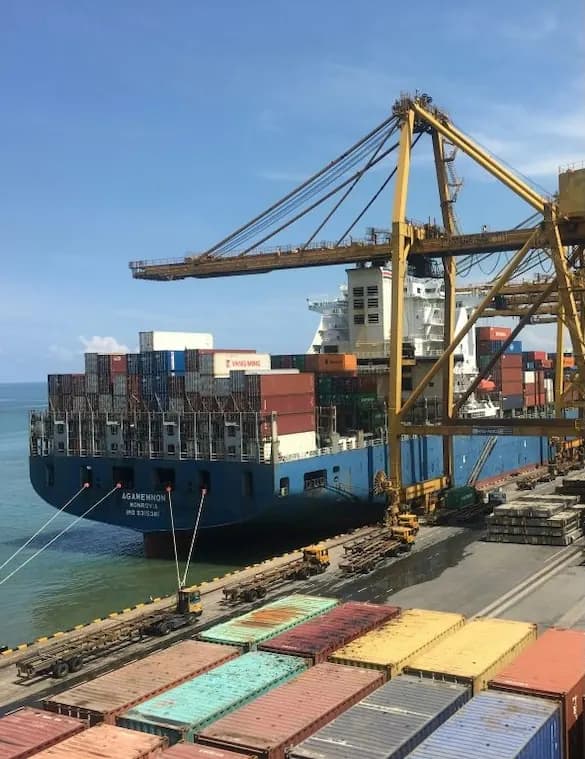
Less than container load
LCL Shipping
LCL shipping is sea freight for cargo that does not fill a container. Your pallets are consolidated with other shippers' cargo at a container freight station, sail in a shared box, and are separated again at the destination CFS. You pay per cubic metre, which makes it the economical choice below about 15 CBM.
How is LCL freight priced?
LCL rates are quoted per weight or measure, written W/M. The carrier charges on whichever is greater: the volume in cubic metres, or the weight in tonnes. For most consumer goods volume wins, so a two CBM shipment weighing 400 kg is billed as two CBM. Dense goods such as ceramics or metal parts can flip that, and a one CBM pallet weighing 1,400 kg is billed as 1.4 units.
| Charge | Basis | Notes |
|---|---|---|
| Ocean freight | Per CBM, one CBM minimum | The sailing itself |
| Origin CFS charges | Per CBM | Receiving, measuring, loading into the container |
| Documentation and customs | Per shipment | Shipping bill, bill of lading, let export order |
| Destination CFS charges | Per CBM | Unloading, sorting, storage within free time |
| Destination clearance and delivery | Per shipment | Included on DDP terms, excluded on FOB and CIF |
Why does LCL take longer than FCL?
The sailing time is the same vessel. The extra days come from consolidation. At origin, the CFS waits for enough cargo to close a container for your destination, typically one weekly sailing. At destination, the shared container is unloaded and each shipper's cargo is separated and cleared. Together these add three to five days at each end compared with a container that goes straight from factory to warehouse.
- Nhava Sheva to Rotterdam: 22 to 28 days sailing plus consolidation, about five weeks door to door
- Mundra to Jebel Ali: 6 to 9 days sailing, about two and a half weeks door to door
- Nhava Sheva to New York: 28 to 36 days sailing, about seven weeks door to door
- Nhava Sheva to Los Angeles: 30 to 40 days sailing, often via Singapore, about eight weeks door to door
How should LCL cargo be packed?
Your cargo will be handled by forklift at least four times and will sit beside other shippers' goods. Pack for that, not for a sealed container.
- 1Palletise everything, on heat-treated pallets stamped ISPM 15 if the destination is the USA, EU or UK
- 2Keep pallets within 120 by 100 cm footprint and under 180 cm height, so they fit a container door and a standard rack
- 3Shrink-wrap and corner-board each pallet, and strap cartons that could shift
- 4Mark every carton and pallet with the consignee, the shipment reference and the piece count
- 5Send the packing list with pallet dimensions before pickup, so the CFS measurement matches the quote
The CFS measures each pallet on receipt. If the measured cube is higher than the packing list, the invoice follows the measurement, so accurate dimensions up front save an argument later.
When is LCL the wrong choice?
- Above roughly 13 to 15 CBM, a 20 ft container is usually cheaper and faster
- Fragile or high-value goods that should not be handled with other cargo
- Deadlines under three weeks to Europe or five weeks to the USA, where air freight or an express ocean product fits better
- Temperature-sensitive goods, since LCL containers are dry boxes only
- Dangerous goods, which most consolidators refuse or surcharge heavily
Below two CBM the destination charges make air freight competitive on total cost, especially to the USA. We will quote air alongside LCL when the volume is that small.
How does a LCL shipping booking work with QShip?
- 1
Share the packing list
Pallet count, dimensions, weight, commodity and destination. We quote W/M with the destination charges shown.
- 2
Book the consolidation
We fix the CFS receiving date to match the weekly closing for your destination.
- 3
Pick up and receive
Cargo is collected by truck, measured and palletised at the CFS, and the shipping bill is filed.
- 4
Consolidate and sail
Your pallets are loaded into the shared container, which moves to the port and is loaded before cut-off.
- 5
Deconsolidate and clear
At the destination CFS the container is unloaded, your cargo separated and customs cleared.
- 6
Deliver
Delivery to your warehouse, a 3PL or a marketplace fulfilment centre with the appointment booked.
Questions customers ask
Transit times, charges and document requirements on this page were last reviewed on 5 September 2026.
Services that usually go with LCL shipping
- FCL ShippingA full 20 or 40 foot container booked for your cargo alone, sealed at origin and opened at destination.Read more
- Ocean FreightSea freight from Indian ports to the USA, Europe and the Middle East, booked as a full container or as part of one.Read more
- Air FreightAirport to airport and door to door air cargo for time-bound consignments, priced on chargeable weight.Read more
- Customs ClearanceShipping bill and bill of entry filing, duty assessment and examination handling at Indian ports and airports.Read more
- Amazon FBA ShippingPrep, labelling and delivery into Amazon fulfilment centres in the USA, UK and Europe as an Amazon SPN partner.Read more